
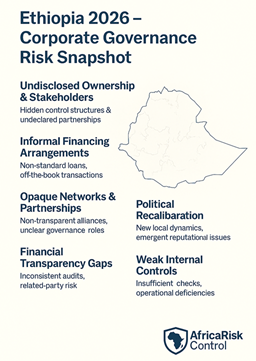
By Africa Risk Control (ARC) – As Ethiopia moves into 2026, due diligence is becoming more complex—and one of the least discussed but most consequential issues is corporate governance weakness among local companies. Africa Risk Control’s (ARC) assessments reveal that governance-related red flags now represent a growing share of operational and reputational risks facing investors, lenders, and international partners.
Several factors are driving this shift. First, the combination of FX shortages, rising operational costs, and administrative friction has placed increasing pressure on local businesses. Some companies are adapting by using unconventional financial arrangements, undisclosed partnerships, or informal networks to keep operations afloat. These coping mechanisms may not appear in official records, but they introduce hidden exposure for foreign partners.
Second, political recalibration has created new incentives for businesses to align with shifting power structures. ARC’s field reporting shows that certain entities previously considered “low-risk” now face shifting local dynamics, reputational concerns, or compliance inconsistencies due to evolving regional and federal relationships. Investors depending solely on documentation frequently overlook this transition risk.
Third, gaps in financial transparency are widening. While many Ethiopian companies maintain legitimate structures, ARC has observed inconsistencies in shareholder declarations, related-party transactions, debt exposure, or internal audits. Without deeper cross-checks, investors may unknowingly enter partnerships with entities carrying unreported liabilities or conflicts of interest.
Governance issues also intersect with operational capacity. Some local firms lack the internal controls, compliance systems, or reporting capabilities required for joint ventures, large procurement contracts, or donor-funded programs. These weaknesses can escalate into contractual disputes, performance delays, or regulatory complications.
The impact is sector-specific:
• Logistics & construction: hidden subcontracting and unverified ownership.
• Agribusiness: informal financing and undocumented supply arrangements.
• Energy & infrastructure: opaque consortium structures or related-party risks.
• Manufacturing: inconsistent compliance documentation and internal audit gaps.
• Technology: data governance and licensing inconsistencies.
ARC’s Ethiopia Country Risk & Due Diligence Report — 2026 Q1 Premium Edition integrates corporate governance risk into its broader political, sectoral, and regional assessment. Using field verification, document-based reconstructions, stakeholder interviews, and local intelligence, the report highlights where governance inconsistencies are rising—and how they may affect investment outcomes in 2026.
As Ethiopia enters a decisive period, investors must expand due diligence beyond standard registry checks. Governance clarity is no longer optional; it is a strategic imperative for market entry, reputation protection, and long-term operational success.
- Request free Executive Summary
- Get the full 107-page Ethiopia 2026 Premium Report
- Book 1-Hour Country Intelligence Briefing with ARC Lead Researcher
EDITOR’S NOTE– Africa Risk Control (ARC) is a due diligence and risk advisory service provider operating in dozens of African countries. Corporate Due Diligence, Risk Advisory, Country Risk Insights, Background Checks, Identity Verification (for banks, governments, and institutions), Verification for Citizenship by Investment / Donations Programs, Verification for Permanent Residency by Investment / Donation Programs, Source Wealth Verification, Competitor Intelligence, and Market Entry Research are some of the major services ARC has been providing.