
Ethiopia’s 2026 operating environment cannot be understood without examining the influence of external shocks and evolving border dynamics. While internal political and security trends are important, Africa Risk Control’s (ARC) field-level assessments show that developments in neighboring countries—especially Sudan—are increasingly shaping Ethiopia’s risk landscape.
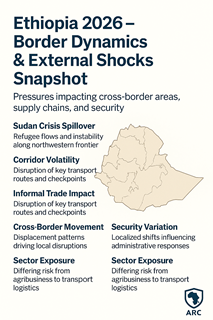
The ongoing conflict in Sudan continues to generate instability along Ethiopia’s northwestern frontier. These pressures influence displacement patterns, cross-border movement, informal trade flows, and local economic activity in border districts. For investors, the impact is often indirect but significant: corridor disruptions, administrative tightening, and shifting security protocols can affect transport timelines, input sourcing, and humanitarian logistics.
Cross-border mobility also affects regional supply chains. Informal trade routes, which play a meaningful role in the flow of goods in both directions, are sensitive to security operations and local clashes. Changes in these patterns can impact pricing, availability of inputs, and the operational reliability of partners who depend on border-linked networks.
The broader Horn of Africa geopolitical environment adds another layer of complexity. Tensions related to regional politics, border disputes, and shifting alliances affect how local authorities respond to security concerns. This influences checkpoint procedures, monitoring of transport corridors, and administrative requirements for goods and personnel moving between regions.
ARC’s Ethiopia Country Risk & Due Diligence Report — 2026 Q1 Premium Edition integrates border pressures into its forward-looking analysis. Using real-time reporting from Ethiopia’s border regions and ARC’s network across 32 African countries, the report provides clarity on how external shocks intersect with domestic political, economic, and security trends.
Sector exposure varies significantly:
• Agribusiness: border disruptions can delay export-bound produce, affect livestock routes, and influence input movement.
• Logistics & Transport: corridor volatility affects delivery timelines, route planning, and cost structures.
• Energy & Infrastructure: projects near border-linked districts may face delays related to land access or local safety conditions.
• Manufacturing: indirect effects appear through supply-chain unpredictability and cost adjustments linked to border dynamics.
What makes border dynamics particularly challenging for investors is their fast-changing nature. National-level reporting often captures macro-level shifts, but the operational realities are hyper-local and evolve quickly. This requires continuous field monitoring and region-specific intelligence to distinguish between temporary disruptions and emerging structural risks.
For organizations entering Ethiopia in 2026, recognizing the influence of border dynamics is critical for accurate risk modeling, project planning, and operational continuity.
Request free Executive Summary
Get the full 108-page Ethiopia 2026 Premium Report
Book a 1-Hour Country Intelligence Briefing with ARC Lead Researcher
, , , ,