
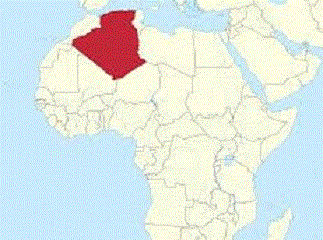
By Africa Risk Control – Algeria has long been one of Europe’s most important energy partners, but recent global shifts in gas supply have renewed its strategic relevance. As European buyers seek diversified and geographically closer sources of natural gas, the North African producer has moved back to the center of Mediterranean energy planning.
Unlike emerging gas exporters that are still developing infrastructure, Algeria operates a mature export system already connected to European markets. The country produces roughly 3.7 trillion cubic feet of natural gas annually and exports significant volumes through both pipelines and liquefied natural gas (LNG) cargoes shipped from its Mediterranean coast.
Two large coastal hubs — Arzew in the west and Skikda in the east — serve as the backbone of Algeria’s LNG industry. From these facilities, cargoes travel mainly to Southern Europe, while additional gas flows directly through pipelines to Italy and Spain. Together, these routes make Algeria one of the closest major gas suppliers to European industry.
From Raw Gas to Industrial Strategy
For decades, Algeria’s energy economy focused primarily on exporting unprocessed hydrocarbons. Today, the country is gradually shifting toward capturing more value from its resources by expanding petrochemical production.
Instead of selling only gas molecules, Algeria aims to export industrial products derived from gas — plastics, chemical feedstocks, and related materials used in manufacturing. This approach allows the country to stabilize revenue against commodity price volatility and participate more directly in industrial supply chains across the Mediterranean.
Because the new facilities are being developed around existing export hubs, much of the activity involves upgrading and integrating infrastructure rather than building entirely new industrial cities. This has turned Algeria into a steady engineering and contracting market where technical services remain in demand even during periods of stable energy prices.
A Reliability-Driven Market
The structure of Algeria’s gas sector makes reliability critical. Hydrocarbon exports account for the majority of the country’s foreign earnings, so maintaining uninterrupted production is a national priority. As a result, investment is often directed toward maintenance, modernization, and efficiency improvements rather than rapid expansion.
This has created a long-term services economy around the energy sector. Contractors involved in equipment maintenance, plant upgrades, and logistics support often find recurring work as facilities require continuous technical intervention to maintain output levels.
In addition, global pressure to reduce emissions is encouraging projects that capture flared gas and improve environmental performance — another area where technical expertise is increasingly required.
Why Businesses Are Paying Attention
Algeria’s combination of large reserves, established infrastructure, and proximity to Europe gives it a distinctive position in global energy markets. The country is not competing with distant exporters but complementing them by offering shorter delivery times and lower transport risk.
For companies seeking participation in the Mediterranean energy economy — whether through services, manufacturing inputs, or supply chain partnerships — Algeria represents a stable and enduring industrial environment rather than a short-term boom market.
Looking Beyond the Market Story
While Algeria’s energy sector offers significant opportunity, understanding how projects actually operate on the ground is essential for companies planning partnerships or contracts. Institutional structures, procurement processes, and supply-chain relationships often determine project outcomes as much as technical capability.
Africa Risk Control has published a detailed operational and risk analysis of Algeria’s gas and petrochemical contracting environment, explaining how the sector functions beyond headline investment announcements.
Read the full analysis on the Africa Risk Control platform
EDITOR’S NOTE– Africa Risk Control (ARC) is a due diligence and risk advisory service provider operating in dozens of African countries. Corporate Due Diligence, Risk Advisory, Country Risk Insights, Background Checks, Identity Verification (for banks, governments, and institutions), Verification for Citizenship by Investment / Donations Programs, Verification for Permanent Residency by Investment / Donation Programs, Source Wealth Verification, Competitor Intelligence, and Market Entry Research are some of the major services ARC has been providing.