
Ethiopia enters 2026 at a moment of profound transformation. Political restructuring, shifting regional alliances, currency pressures, and an evolving security environment are reshaping the country’s investment climate in real time. A new 107-page premium risk and due diligence report released this week by Africa Risk Control (ARC) provides one of the most detailed and field-verified assessments to date, combining investigative reporting with intelligence analysis to help investors navigate the year ahead.
The Ethiopia Country Risk & Due Diligence Report — Premium Edition 2026/Q1 draws on ARC’s 32-country journalist network and uses human-source intelligence (HUMINT), ground-level validation, and multi-source triangulation. The result is a product that digs beneath public narratives to uncover the political, economic, security, and regulatory realities shaping Ethiopia’s outlook.
According to the report, federal–regional relations remain the single most influential variable for investment stability. The dynamics between Addis Ababa, Amhara, Oromia, Tigray and the peripheries continue to evolve, and the report outlines several conflict pathways—including drone warfare trends, militia mobilization patterns, and the reorganization of political actors—that may influence the business landscape in 2026.
Economically, ARC notes that Ethiopia faces persistent FX shortages, inflationary pressure, and a widening gap between the official and parallel exchange rates. A section dedicated to macro-financial trends provides 12-month scenario projections and identifies the key drivers investors should monitor, including government fiscal strategy, import compression trends, and debt exposure.
On the regulatory side, the report outlines risk areas such as licensing delays, FX repatriation challenges, compliance hurdles, and unpredictable policy shifts. It also highlights positive openings, including sector-specific reforms across telecom, digital services, energy, agriculture, logistics, and mining.
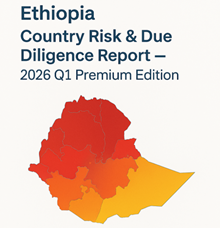
One of the report’s strongest contributions is its regional risk heat map, which uses mixed-intensity shading instead of oversimplified red/yellow classifications. This provides a realistic picture of Ethiopia’s diverse sub-national environments, where no region is entirely low- or high-risk. The heat map is supported by a detailed indicators table covering political, security, economic, and ESG dimensions.
The report also provides sector-level opportunities and risks across nine major sectors. From agribusiness potential in the Rift Valley to logistics corridors, renewable energy expansions, mining prospects, industrial parks, and fintech adoption, the analysis blends opportunity with necessary caution.
Another notable element is ARC’s new 2026–2027 medium-term forecast, which outlines three probability-weighted scenarios: managed stabilization, prolonged stagnation, and multi-front escalation. The forecast is paired with investor implications, allowing organizations to assess how each scenario would affect capital allocation, operational planning, and partnership risk.
For decision-makers, the report’s red-flag checklist offers a practical tool for screening partners, licenses, land arrangements, community environments, and politically exposed networks. ARC also provides a full set of mitigation strategies covering political, security, regulatory, financial, operational, corruption-related, and ESG-related exposures.
Overall, the report stands out for its depth, intelligence-led methodology, and field-based insights. In a year where Ethiopia’s risk-reward balance will shape investor outcomes, ARC’s new publication offers a timely and authoritative roadmap.
The full 107-page report is now available with a Premium Package option that includes a one-hour private intelligence briefing for organizations seeking tailored guidance.