
By Africa Risk Control – Selecting the right local partner has always been essential in Ethiopia, but ARC’s 2026 assessments show that the stakes are now significantly higher. As political dynamics shift, forex constraints deepen, and localized conflict patterns evolve, the reliability of a local partner can determine whether a project succeeds, stalls, or fails.
One of the major challenges today is the widening gap between official documentation and real operational behavior. While many Ethiopian companies maintain legally compliant structures on paper, ARC’s fieldwork reveals discrepancies such as undisclosed shareholders, informal networks, political exposure, related-party risks, or financial inconsistencies. These issues rarely appear in registry documents but can introduce serious reputational, financial, or compliance exposure.
Political recalibration amplifies these risks. The influence of local elites, business networks, or political actors varies widely across regions, especially as federal–regional alignment shifts. A partner considered low-risk in 2022 may face new pressures or changing dynamics in 2026. Investors relying on outdated assumptions may inadvertently align with entities whose standing has shifted in ways not visible on the surface.
Forex shortages introduce additional complications. Partners under financial pressure may adopt informal financing channels, unverified sourcing relationships, or workaround arrangements that place foreign investors at risk. Africa Risk Control’s field assessments show that forex strain is one of the primary drivers of governance deterioration.
Security conditions also impact partner reliability. Companies operating in or near areas of intermittent security pressure may struggle with workforce stability, route planning, or delivery timelines. These operational risks can cascade upward to investors, affecting project continuity, KPIs, and contractual obligations.
Sector-specific exposure intensifies the importance of partner vetting.
• Agribusiness partners may rely on informal supply chains.
• Logistics partners may face route volatility.
• Manufacturing partners may struggle with import delays.
• Construction partners may use subcontractors with unverified profiles.
• Energy and infrastructure partners may face community-relations or land-access challenges.
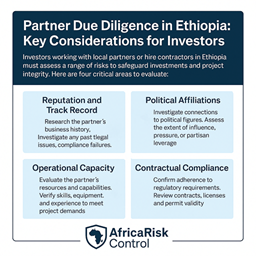
Partner due diligence in 2026 requires more than document checks. It requires HUMINT-style verification, stakeholder interviews, local reputation assessment, financial clarity checks, and mapping of political affiliations and operational history.
ARC’s Ethiopia Country Risk & Due Diligence Report — 2026 Q1 Premium Edition outlines the partner-related red flags investors must watch, along with workable frameworks for verifying credibility, integrity, and operational capacity.
In 2026, the right partner can unlock opportunity — but the wrong one can compromise entire investments.
EDITOR’S NOTE– Africa Risk Control (ARC) is a due diligence and risk advisory service provider operating in dozens of African countries. Corporate Due Diligence, Risk Advisory, Country Risk Insights, Background Checks, Identity Verification (for banks, governments, and institutions), Verification for Citizenship by Investment / Donations Programs, Verification for Permanent Residency by Investment / Donation Programs, Source Wealth Verification, Competitor Intelligence, and Market Entry Research are some of the major services ARC has been providing.
To learn more about Africa risk Control’s enhanced due diligence services in African countries, book 20 minute free consultations now.