
By Africa Risk Control – Egypt is one of Africa’s most consequential contracting and logistics markets because it sits at the intersection of three forces: strategic geography, large-scale state-linked development, and accelerating energy and infrastructure build-out.
For foreign investors, EPC contractors, equipment suppliers, and financial partners, Egypt offers frequent deal flow—but it is also an environment where the risk profile is often shaped less by the technical scope and more by counterparty structure, procurement pathways, and the integrity of contracting chains.
The macro context underlines why the market remains investable. The IMF DataMapper profile for Egypt reflects a large economy (GDP in current prices shown around US$399.5 billion) and recent real GDP growth readings around 4–4.5% (depending on dataset vintage). But macro indicators only tell part of the story. In Egypt, the “deal reality” is that many transactions connect to state-linked entities, large consortiums, layered subcontracting, and cross-border financing—all of which raise the value of Enhanced Due Diligence (EDD) in partner selection and vendor onboarding.
Why Egypt sells right now: megaproject-driven capital and contractor intensity
Egypt was a primary driver of Africa’s rebound in foreign investment inflows in 2024, with UNCTAD noting that Africa’s FDI surge was significantly driven by a megaproject in Egypt’s Ras El-Hekma peninsula. For contracting markets, the implication is straightforward: megaproject headlines translate into procurement ecosystems—EPC awards, subcontractor networks, local-content structures, specialist suppliers, logistics providers, and service vendors.
In parallel, Egypt’s logistics relevance is anchored by the Suez Canal and associated port, maritime, and industrial corridor ecosystems. Yet the last few years have shown how geopolitical shocks can rapidly reshape trade routing and cashflows. In 2024, credible reporting cited a sharp drop in Suez Canal revenues and traffic as Red Sea insecurity diverted shipping, with 2024 canal transits reported down about 50% year-on-year.
This matters for investors because it changes the operating environment for logistics-adjacent counterparties (port services, ship services, warehousing, bonded zones, trucking, and trade finance) and can introduce stress, opportunism, and integrity risk in contracting behavior.
How the sector performed in the last five years
Over the past five years, Egypt’s logistics and infrastructure contracting landscape has moved through a cycle of expansion, shock response, and repricing.
In the earlier part of the period, Egypt’s infrastructure pipeline continued to absorb large volumes of contracting capacity. As projects scale, procurement and delivery models tend to widen into multi-tier subcontracting. That is usually where risk begins to compound: beneficial ownership (UBO) opacity becomes easier to hide in second- and third-tier vendors; “agents” and intermediaries can appear in tendering pathways; and payment disputes can migrate down the chain, creating incentives for corner-cutting and documentation gaps.
The more recent period added an external shock to logistics economics. Red Sea insecurity materially reduced Suez Canal traffic and revenues in 2024, according to major outlet reporting and canal-authority-cited figures. For investors, the key takeaway is not simply “logistics risk exists,” but that exogenous disruption can quickly pressure counterparties’ cash positions—raising the probability of distressed behavior, disputes, and non-transparent financing arrangements.
Meanwhile, megaproject-linked investment narratives have increased the volume of counterparties seeking to position themselves as “approved” contractors, local partners, or specialist vendors—an environment where verification of track record, licensing claims, and true control becomes commercially decisive.
Where investors and partners can find opportunity
Egypt’s opportunity set in this theme clusters into three deal corridors.
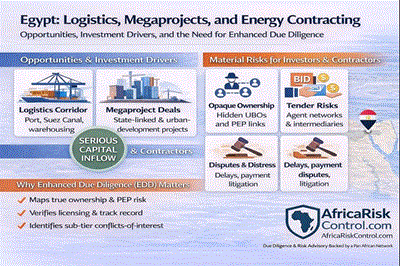
The first is the megaproject and urban-development corridor: large construction packages, utilities, real estate infrastructure, and supporting services where foreign firms often enter via consortiums, EPC roles, specialist subcontracts, or supplier frameworks.
The second is the logistics/port/industrial corridor: port services, warehousing, customs and bonded operations, industrial zones, and transport services tied to trade flows and rerouted volume dynamics. Even in disrupted environments, the “infrastructure of trade” retains long-run demand, but counterparties must be selected with discipline.
The third is the energy-transition contracting corridor: grid upgrades, renewable integration components, energy efficiency retrofits, and industrial energy services—segments that often bring additional compliance sensitivity due to equipment classifications, dual-use concerns in some supply chains, and higher international screening requirements.
Deal landscape and entry pathways: how parties actually enter Egypt
In practice, foreign participation commonly takes one of five forms: direct EPC participation; subcontractor/specialist roles under prime contractors; vendor onboarding into approved supplier lists; project finance or structured lending tied to assets; and partnership/JV approaches to satisfy local operational requirements.
Where deals fail is rarely in the entry memo. Failure happens later, in procurement ambiguity, change-order disputes, payment delays, or compliance surprises discovered after significant exposure has already been taken. The most common failure pattern is that a counterparty looks credible at the top line (website, references, claimed awards), but the underlying governance and ownership trail does not withstand scrutiny.
EDD risk map: what goes wrong in Egypt’s contracting chains
In Egypt’s logistics and megaproject contracting ecosystem, the most material risks tend to cluster around integrity of counterparties and transaction pathways.
Beneficial ownership opacity is a recurring risk in layered holdings and subcontracting structures. If the true controlling interests are not clear, it becomes difficult to assess conflicts of interest, related-party transactions, or undisclosed politically exposed person (PEP) connections.
PEP exposure and government touchpoints are a second risk node. Large infrastructure and logistics projects frequently involve licensing, permits, land interfaces, customs processes, and regulatory engagement. Where intermediaries insert themselves into these touchpoints, the risk profile changes quickly.
Procurement integrity and tender risk is a third cluster. Even when processes are formally structured, practical reality can involve agent networks, “fixers,” or politically connected facilitators. This is exactly the zone where EDD creates measurable value: it separates genuine delivery capability from influence-based market access that can evaporate or create enforcement risk.
Sanctions, export controls, and dual-use sensitivity can also appear, particularly where energy infrastructure, ports, or certain equipment categories are involved. For internationally exposed investors, screening is not optional; it is a prerequisite for bankability.
Finally, litigation, payment disputes, and distressed counterparties can become a practical risk factor, especially under macro pressure or logistics disruptions. That is not just a legal issue—it is a performance, delivery, and reputational issue.
Practical risk mitigation: what disciplined investors actually do
The most effective approach in Egypt is to treat counterparty integrity as a project-control tool, not a compliance afterthought.
A strong mitigation posture typically includes staged exposure (milestone-based commitments), contractual audit rights, clear termination triggers tied to ownership changes or adverse findings, and explicit prohibitions on undisclosed intermediaries.
Operationally, investors should insist on visibility through the subcontracting chain. If a prime contractor can freely substitute second-tier vendors without disclosure, you are not managing risk—you are inheriting it.
Finally, investors should normalize ongoing monitoring. In contracting ecosystems, the risk profile can change mid-project: shareholder shifts, new intermediaries, adverse media, or enforcement actions can appear after initial onboarding. Monitoring triggers should be written into governance.
Why Enhanced Due Diligence is the differentiator in Egypt
In Egypt’s megaproject and logistics-linked contracting environment, the biggest risks are usually not technical. They are hidden in ownership, influence pathways, and the integrity of procurement chains. Standard checks will not surface those reliably.
Enhanced Due Diligence (EDD) does. EDD clarifies who controls the counterparty, what affiliations matter, whether there are PEP connections or conflicts of interest, whether licensing and track record claims are verifiable, and whether the company’s commercial posture matches its real operating footprint.
For foreign partners, this is not theoretical. EDD becomes the mechanism that allows you to justify counterparties internally, bank transactions, and protect your brand when scrutiny increases.
ARC Due Diligence support (Corporate + Individual)
Africa Risk Control supports Egypt-related transactions through two complementary tracks.
Corporate Enhanced Due Diligence focuses on beneficial ownership and control mapping, sanctions/adverse media screening, litigation and regulatory standing, related-party risk, and integrity red flags across the entity and its critical subcontractors or intermediaries.
Individual Enhanced Due Diligence focuses on key principals and executives, major shareholders, agents/intermediaries, and any stakeholder with real influence over permits, tender outcomes, customs pathways, or high-risk decisions—covering identity/background verification, PEP mapping, conflicts-of-interest indicators, and reputation risk profiling.
EDITOR’S NOTE:
BEHAK is an Africa-focused strategic communications and public relations firm headquartered in Addis Ababa, Ethiopia. Established in 2019 by veteran journalists, the firm delivers public relations services grounded in credibility, media intelligence, and a deep understanding of Africa’s political, institutional, and media landscapes.
BEHAK’s work spans five core service areas: Strategic Communication & Advisory, Media Relations & Publicity, Crisis Management & Response, Digital PR & Content Marketing, and Event Management & Measurement, supporting organizations seeking to build trust, manage reputation, and engage effectively with regional and global audiences.