
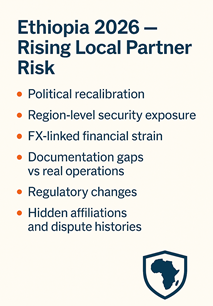
Local partner selection remains one of the most decisive factors shaping investment success in Ethiopia, yet many organizations continue to conduct only surface-level verification. As Ethiopia moves through 2026, Africa Risk Control’s (ARC) field intelligence shows that local partner risk is rising, driven by political recalibration, regional security variation, FX-linked financial strain, and increased regulatory complexity.
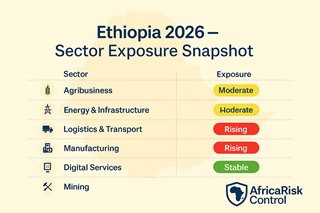
One of the key challenges in 2026 is the widening gap between official records and actual operational reality. Business registrations, licenses, compliance certificates, and financial filings may appear legitimate, but ARC’s on-the-ground investigations often reveal discrepancies in ownership, governance, affiliations, or operational capacity. This is particularly relevant in sectors such as logistics, agribusiness, construction, energy, and mining — where partner reliability directly determines project feasibility.
According to the latest Ethiopia Cpountry Risk profile 2026 report by Africa Risk Control (ARC)political fluidity is also reshaping the risk environment. Shifting alliances between federal and regional actors affect the influence, access, and protection enjoyed by local partners. Stakeholders who were strong in previous years may now face reputational or administrative vulnerabilities. Conversely, emerging groups may wield influence that does not yet appear in public records. Investors who overlook these dynamics risk partnering with entities whose political positioning is no longer aligned with stability.
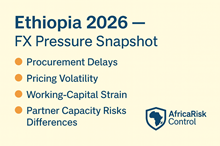
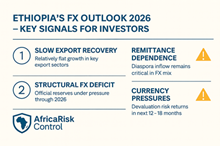
Financial strain, particularly due to FX shortages, is another factor increasing partner risk. Companies reliant on imported inputs may face liquidity pressure that is not visible in their documentation. ARC’s assessments show that some partners increasingly depend on informal financing, side networks, or workaround arrangements that expose investors to compliance and operational risk.
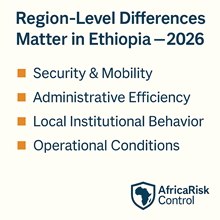
The report also stresses that local conflicts and regional security shifts also affect partner performance. A partner with headquarters in Addis Ababa may still operate in regions affected by mobility restrictions, administrative delays, or community-level tensions that do not appear in official documentation. Understanding where a partner actually operates — and under what conditions — is essential.
Regulatory changes further complicate due diligence. As licensing procedures, institutional behavior, and administrative requirements shift across regions, partners with outdated or incomplete compliance strategies may expose investors to delays, penalties, or renegotiations.
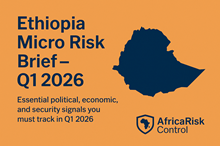
ARC’s Ethiopia Country Risk & Due Diligence Report — 2026 Q1 Premium Edition also provided a structured framework for evaluating local partner exposure. Using field verification, regional intelligence, political–economic analysis, and sector mapping, ARC enables investors to assess the real risk landscape surrounding potential partners. The summary version of of this report, Ethiopia Micro Risk Brief Q1/2026 has also reflected on the key investment and security related issues every investor must watch in Ethiopia during the first quarter of 2026.
In a rapidly evolving environment, organizations must elevate local partner due diligence beyond document checks. The cost of inaccurate assumptions is rising — and in 2026, it may determine the success or failure of investment initiatives.
Launched in mid 2025 with boots-on-the ground in 32 plus African countries and networks of award-winning business and investigative journalists, ARC has been engaged in investment risk advisory services, and production of exclusive risk reports.
The company in its mission statement stated that it is dedicated to build investor confidence in Africa by delivering rigorous due diligence and actionable intelligence that connects global investors with trustworthy local partners, driving sustainable growth and impact across the continent.