
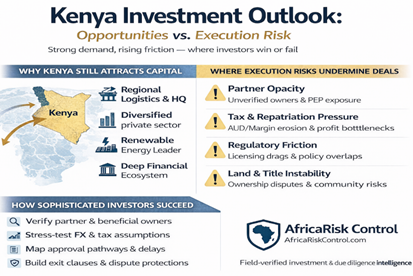
By Africa Risk Control (ARC) – Kenya continues to position itself as East Africa’s primary commercial and financial gateway, attracting foreign investors seeking regional scale, diversified demand, and relatively mature institutions.
Nairobi remains the region’s leading hub for fintech, logistics, professional services, and multinational headquarters. However, while opportunity remains real, the margin for error in Kenya has narrowed. The investment story today is increasingly defined by execution discipline rather than market access alone.
Where Investors Are Still Finding Value
Several sectors continue to attract sustained foreign interest:
- Renewable energy and power solutions remain a core strength. Kenya’s geothermal leadership, combined with growing demand for commercial and industrial (C&I) power, has created opportunities in grid-scale generation, captive power, and mini-grid solutions—particularly for industrial parks and agribusiness.
- Digital economy and fintech continue to evolve beyond consumer payments. The next phase of growth is visible in SME credit, embedded finance, B2B platforms, logistics tech, and agri-tech solutions that reduce inefficiencies across value chains.
- Agribusiness and value addition remain underpenetrated. Export-oriented horticulture, dairy, grains, cold-chain logistics, and food processing offer attractive upside, particularly where investors can integrate storage, processing, and compliance capabilities.
- Logistics, warehousing, and industrial real estate are also gaining traction as Kenya consolidates its role as a distribution hub for Uganda, Rwanda, South Sudan, and eastern DRC.
The Risks Investors Underestimate
Despite these opportunities, Kenya has become a higher-friction operating environment than many first-time investors anticipate.
Foreign exchange pressure and dollar liquidity constraints affect import-heavy sectors and profit repatriation planning. Fiscal stress has increased the intensity of tax enforcement, audits, and retrospective assessments, particularly for foreign-owned firms.
Regulatory execution risk—rather than formal policy—has become a central challenge. Licensing timelines, county–national overlaps, and informal administrative bottlenecks regularly delay projects. Political and social tensions, while episodic, can disrupt operations and logistics when protests escalate.
Partner and counterparty risk is another frequent failure point. Investors often rely on politically connected intermediaries who offer speed but introduce long-term compliance, reputational, and continuity risks—especially when political alignments shift.
Why Structured Risk Management Matters
Kenya remains investable, but success increasingly depends on robust pre-entry due diligence, partner verification, and regulatory pathway mapping. Projects fail less often because of weak demand, and more often due to ownership opacity, undisclosed liabilities, land or permitting issues, and misaligned incentives with local partners.
This is precisely where on-the-ground intelligence and investigative due diligence make the difference.
ARC’s Kenya analysis goes beyond surface-level opportunity, examining who really controls assets, how approvals actually move, and where investors are most exposed—before capital is committed.
Read the full ARC Kenya Investment and Risk Insight here on ARC website.