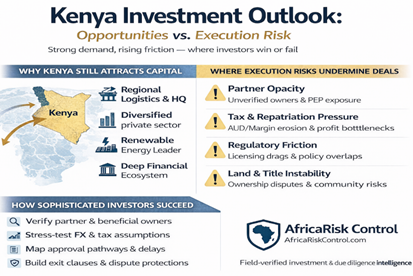


By Africa Risk Control – As 2026 begins, Kenya’s economic narrative has shifted from one of emerging potential to one of institutional maturity. Positioned as the undisputed financial and logistical anchor for the 400-million-person East African Community (EAC), Kenya is currently navigating a pivotal phase of its development.
With real GDP growth projected to stabilize around 5.0%, the nation is outperforming many of its continental peers by leveraging a unique combination of green energy leadership and a rapidly digitizing private sector. However, for global capital, the “Silicon Savannah” of 2026 presents a landscape where opportunity is inextricably linked to regulatory and fiscal complexity.
The Shift Toward Green Industrialization
The most significant evolution in the Kenyan market is the transition from power generation to green manufacturing. Having achieved a grid that is over 90% renewable, Kenya has moved beyond the “proof of concept” stage for its geothermal and wind assets. In 2026, the strategic focus is on “Direct-Use” geothermal applications.
By establishing industrial hubs directly adjacent to steam fields in the Rift Valley, Kenya is offering a “green premium” for international manufacturers looking to decouple their supply chains from carbon-heavy energy sources.
This energy abundance is acting as a catalyst for value-added agribusiness and light manufacturing. However, the expansion of these physical assets has brought land tenure and community engagement risks to the forefront. Investors are finding that traditional due diligence is evolving; it now requires a granular understanding of historical land roots and a sophisticated approach to ESG (Environmental, Social, and Governance) compliance to ensure long-term project viability.
Digital Sovereignty and the AI Frontier
Nairobi’s tech ecosystem has also undergone a structural transformation. In 2026, the conversation has moved from basic fintech to AI governance and data sovereignty. Following the implementation of more rigorous data residency laws, there is a surge in demand for Tier III and IV data centers that can provide localized storage for the region’s expanding digital economy. The “Digital Superhighway” initiative has largely bridged the connectivity gap, but it has introduced new regulatory hurdles regarding cybersecurity and intellectual property rights.
While the tech sector remains a high-growth magnet, it is increasingly sensitive to the broader macroeconomic environment. The government’s ongoing fiscal consolidation—aimed at managing a debt-to-GDP ratio of approximately 65.7%—has led to a more assertive tax administration. The Kenya Revenue Authority (KRA) now employs real-time digital monitoring, making corporate tax transparency a non-negotiable requirement for any foreign entity operating in the hub.
Navigating the 2026 Risk Landscape
The primary challenge for 2026 is the “political friction” associated with the one-year countdown to the 2027 general elections. Historically, this period in the Kenyan cycle is marked by policy caution and shifts in spending priorities. Savvy investors are currently prioritizing deep-tier situational analysis to distinguish between temporary political rhetoric and fundamental shifts in the investment climate.
Moreover, the maturity of the market has made “personnel risk” a critical variable. As local corporate structures become more complex, verifying the beneficial ownership and reputational standing of local partners is now a standard pillar of risk mitigation. In a landscape where digital registries may not always reflect the most current informal power shifts, the necessity for independent, on-the-ground verification has become the standard for institutional capital.
Kenya remains a high-reward environment, but it is one that now punishes the unprepared. The successful ventures of 2026 will be those that balance their pursuit of yield with a rigorous, investigative approach to the market’s unique institutional nuances.
Read the full analysis on Africa Risk Control’s website: Safeguarding Capital: Navigating Kenya’s 2026 High-Growth Investment Frontiers
EDITOR’S NOTE: Africa Risk Control (ARC) is a due diligence and risk advisory service provider operating in dozens of African countries. Corporate Due Diligence, Risk Advisory, Country Risk Insights, Background Checks, Identity Verification (for banks, governments, and institutions), Verification for Citizenship by Investment / Donations Programs, Verification for Permanent Residency by Investment / Donation Programs, Source Wealth Verification, Competitor Intelligence, and Market Entry Research are some of the major services ARC has been providing.