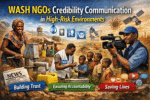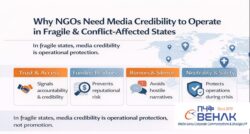
By BEHAK PR Solutions – In fragile and conflict-affected environments, non-governmental organizations operate under conditions that extend far beyond humanitarian urgency. Their work unfolds amid political sensitivity, heightened suspicion, and constant scrutiny from authorities, donors, communities, and armed or non-state actors. In such contexts, credibility is not abstract. It is operational.
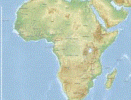
Across Africa, NGOs play a central role in delivering services where state capacity is limited or absent. They provide healthcare, education, humanitarian relief, climate adaptation support, and livelihood assistance to populations that governments and markets often cannot reach consistently. Their ability to operate depends not only on technical expertise or funding, but on trust—earned, sustained, and continuously reassessed. This reality is most visible in fragile states.
Filling the Gaps Left by Fragility
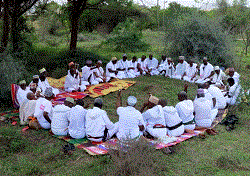
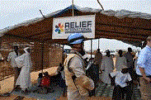
In conflict-affected countries, NGOs frequently become the primary service providers in large geographic areas. They deliver food assistance, emergency healthcare, water and sanitation services, protection programs for displaced populations, and basic livelihood support. In many cases, these services are delivered in environments where government institutions lack territorial control, administrative reach, or financial capacity.
In countries such as South Sudan, years of conflict and economic instability have produced conditions where humanitarian and development organizations are essential to civilian survival in multiple regions. Access to communities is negotiated carefully. Neutrality is scrutinized. Operational permissions can change quickly. In such environments, perception and legitimacy shape whether an organization can continue its work.
Credibility as a Gatekeeper to Access
For NGOs operating in fragile states, access is rarely automatic. It must be earned and repeatedly reaffirmed. Governments, local authorities, community leaders, donors, and international partners all assess whether an organization can be trusted to operate responsibly and impartially.
Media credibility plays a critical role in this assessment. Credible, independent media coverage signals that an organization’s activities have been observed, contextualized, and publicly documented by third parties. It demonstrates that the organization is not operating invisibly or without accountability.
In environments where suspicion is high and misinformation spreads easily, this external validation matters. An NGO with a consistent and verifiable public record is easier to defend—to donors, regulators, and local stakeholders. One without such a record may face delays, additional scrutiny, or restrictions, regardless of the quality of its programs.
The Risks of Silence
Some NGOs working in sensitive contexts choose to limit public visibility out of concern that media exposure could compromise neutrality or attract political attention. While discretion is often necessary, complete silence can create unintended risk.
In fragile environments, silence produces information gaps. Those gaps are often filled by rumor, speculation, or hostile narratives. Without credible public references, external actors may infer motives, affiliations, or competence without evidence.
Strategic communication does not require advocacy or self-promotion. It requires ensuring that accurate, neutral information about an organization’s mission, approach, and track record is available through trusted channels.
Media as Institutional Protection
For NGOs in fragile and conflict-affected states, media engagement should not be understood as visibility for its own sake. It functions as institutional protection.
Responsible media coverage—through humanitarian reporting, contextual features, or expert commentary—creates a reputational buffer. This buffer becomes critical during periods of accusation, operational disruption, or political pressure. When questions arise, an organization with an established public record can respond from a position of documented credibility rather than silence.
In contexts such as South Sudan and similar fragile environments, NGOs with visible and credible media records are often better positioned to withstand scrutiny because their narratives already exist outside internal reports and donor communications.
Funding Decisions Begin Before Proposals Are Read
Donors supporting operations in fragile states face heightened accountability obligations. Funding decisions increasingly begin with reputational screening before proposals are formally evaluated. Media reviews, background checks, and public record assessments are now standard components of risk management.
Donor institutions must reassure boards, taxpayers, and oversight bodies that funds are not exposed to reputational or political risk. NGOs with a consistent, credible public footprint are easier to approve and easier to justify internally. Their leadership appears accountable. Their operations appear transparent.
This does not require constant media exposure. It requires sustained, accurate, and responsible presence over time.
Communicating Complexity Without Losing Neutrality
Humanitarian and development work in fragile states is inherently complex. Programs face delays. Access fluctuates. Security conditions evolve. Communicating this complexity responsibly is a sign of institutional maturity.
Media engagement allows NGOs to contextualize challenges, explain constraints, and demonstrate adaptive capacity. This transparency often strengthens trust rather than undermining it. Donors and partners understand that fragile environments are unpredictable; what they require is honesty and professionalism.
Strategic communication helps NGOs balance visibility with neutrality, ensuring that information is shared without politicization or sensationalism.
Digital Validation and Professional Discourse
Beyond traditional media, NGOs increasingly operate within a digital ecosystem shaped by policy analysts, humanitarian practitioners, journalists, and development professionals. These actors influence discourse within donor and policy communities.
When such voices reference an organization’s work through informed analysis or professional commentary, legitimacy is reinforced. This is not influencer marketing. It is peer validation within relevant expert communities.
Used carefully, these engagements complement earned media and strengthen credibility without compromising neutrality.
Reputational Risk Is Operational Risk
In fragile states, reputational risk and operational risk are inseparable. Loss of trust can lead to restricted access, funding suspensions, or program interruption. Strong reputational standing, by contrast, can facilitate coordination, protect staff, and stabilize operations during periods of volatility.
This is why public relations for NGOs in fragile contexts should be understood as institutional safeguarding and risk management—not promotion.
Conclusion: Credibility Sustains Presence
In conflict-affected and fragile states, NGOs are often the last line of support for vulnerable populations. Their ability to operate depends on more than logistics and funding. It depends on trust.
Media credibility helps build that trust. It supports access, reassures donors, and protects institutional legitimacy in environments where misunderstanding can have serious consequences.
For NGOs operating in fragile states, strategic communication is not about attention. It is about ensuring that critical work can continue—credibly, safely, and sustainably.
EDITOR’S NOTE:
BEHAK is an Africa-focused strategic communications and public relations firm headquartered in Addis Ababa, Ethiopia. Established in 2019 by veteran journalists, the firm delivers public relations services grounded in credibility, media intelligence, and a deep understanding of Africa’s political, institutional, and media landscapes.
BEHAK’s work spans five core service areas: Strategic Communication & Advisory, Media Relations & Publicity, Crisis Management & Response, Digital PR & Content Marketing, and Event Management & Measurement, supporting organizations seeking to build trust, manage reputation, and engage effectively with regional and global audiences.