
By BEHAK – Access to safe water, sanitation, and hygiene (WASH) remains one of the most fundamental development challenges across Africa. In environments affected by poverty, displacement, climate stress, and weak infrastructure, WASH programs are often the difference between stability and crisis. Non-governmental organizations working in this space frequently operate where public systems cannot reach or sustain services.
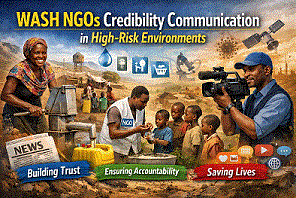
In such high-risk environments, credibility is as important as technical delivery. Communities must trust that services are safe. Governments must trust that standards are met. Donors must trust that resources are used responsibly. Strategic communication and credible media presence play a central role in sustaining that trust.
Across Africa, non-governmental organizations (NGOs) play a critical role in delivering essential services, supporting vulnerable communities, and implementing development programs in areas where state capacity is limited or absent. From rural healthcare and education to humanitarian response, climate adaptation, and livelihood support, NGOs often operate at the frontline—reaching populations that governments, markets, and formal institutions struggle to serve consistently.
Their ability to operate effectively depends not only on technical capacity, but also on trust, credibility, funding continuity, and public accountability.
WASH Programs Operate Where Failure Has Immediate Consequences
Unlike some development interventions whose impacts unfold gradually, failures in WASH programs can have immediate and severe consequences. Unsafe water sources can trigger disease outbreaks. Poor sanitation can exacerbate public health risks. Inadequate hygiene practices can undermine entire health systems.
Because of this, WASH NGOs operate under heightened expectations. Their work is closely linked to public health outcomes, child mortality, and community resilience. Any doubt about credibility can quickly undermine program effectiveness.
A WASH Context in Chad
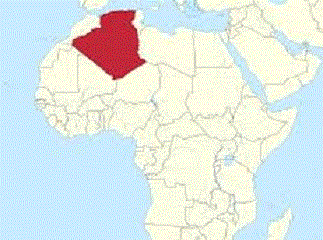
In Chad, access to clean water and sanitation remains a persistent challenge, par ticularly in rural areas and displacement-affected regions. Climate variability, limited infrastructure, and geographic isolation place additional strain on already fragile systems.
NGOs play a central role in constructing boreholes, rehabilitating water points, promoting hygiene education, and supporting community-based water management structures. In many areas, these organizations are the primary providers of WASH services.
Operating in such environments requires more than engineering solutions. It requires trust—from communities who rely on the safety of water sources, from authorities who oversee standards, and from donors who finance interventions.
Why Media Credibility Matters for WASH NGOs
WASH programs are often technical and difficult for non-specialists to evaluate. Donors and partners may not have the expertise to assess water quality protocols, sanitation systems, or hygiene methodologies directly.
Credible media coverage helps translate technical work into understandable narratives. When independent outlets document how NGOs are improving water access or preventing disease outbreaks, they provide third-party validation that reassures stakeholders.
This validation is particularly important in high-risk environments, where misinformation can spread quickly and undermine confidence in life-saving interventions.
Beyond Project Reports and Technical Assessments
WASH NGOs produce detailed engineering reports, monitoring data, and compliance documentation. These materials are essential for accountability but are typically consumed by a narrow technical audience.
Media engagement expands understanding beyond this circle. It helps policymakers, secondary donors, and the broader public grasp why certain interventions matter and how they protect community health.
A single responsible media feature can often communicate credibility more effectively than extensive technical documentation alone.
Communicating Risk and Responsibility
High-risk environments demand transparency. Equipment failures, access constraints, or contamination risks must be managed openly and professionally.
Strategic communication allows WASH NGOs to explain risks, corrective measures, and quality assurance processes. This transparency builds confidence and demonstrates institutional maturity.
Avoiding communication, by contrast, can allow doubts to fester—even when problems are being addressed responsibly.
Digital Voices and Public Health Confidence
Public health discourse increasingly takes place on digital platforms, where health professionals, development practitioners, and analysts discuss water safety, sanitation standards, and disease prevention.
When such voices engage constructively with WASH programs—by referencing evidence, acknowledging impact, or contextualizing challenges—they reinforce credibility. This is not promotion. It is professional discourse that strengthens trust.
For WASH NGOs, thoughtful engagement with these voices complements earned media without compromising neutrality.
Reputation and Funding Continuity
Funding for WASH programs often depends on sustained donor confidence. Donors need assurance that interventions are safe, effective, and accountable, particularly when working in fragile environments.
NGOs with clear, consistent public records are easier to support. Their work is easier to explain internally. Their risk management appears robust.
Strategic communication therefore contributes directly to funding stability.
WASH as a Public Trust Function
Water and sanitation are deeply tied to public trust. Communities must believe that water is safe. Parents must trust that facilities protect children. Authorities must trust that standards are upheld.
Media credibility supports this trust by ensuring that accurate information about WASH programs is available publicly and independently.
Credibility Sustains Essential Services
WASH NGOs operate in environments where trust can mean the difference between health and disease. In such contexts, credibility is not an abstract concept. It is operational.
Responsible media engagement and strategic communication help WASH NGOs demonstrate accountability, reinforce public confidence, and sustain life-saving services. In high-risk environments like Chad, visibility is not about attention. It is about safeguarding essential systems through trust.
EDITOR”S NOTE: BEHAK, an Africa-based strategic communications and media advisory firm headquartered in Addis Ababa, works with NGOs, development agencies, and mission-driven enterprises to strengthen credible media visibility across African and international platforms.
Through structured media engagement, narrative development, leadership profiling, and policy-focused communication strategy, BEHAK enables organizations to translate complex field operations into clear, defensible public narratives. Its approach prioritizes accuracy, institutional maturity, and long-term reputation management — ensuring that impactful climate and humanitarian work receives the visibility and recognition it merits within competitive funding and policy environments.